The Interpretation Gap
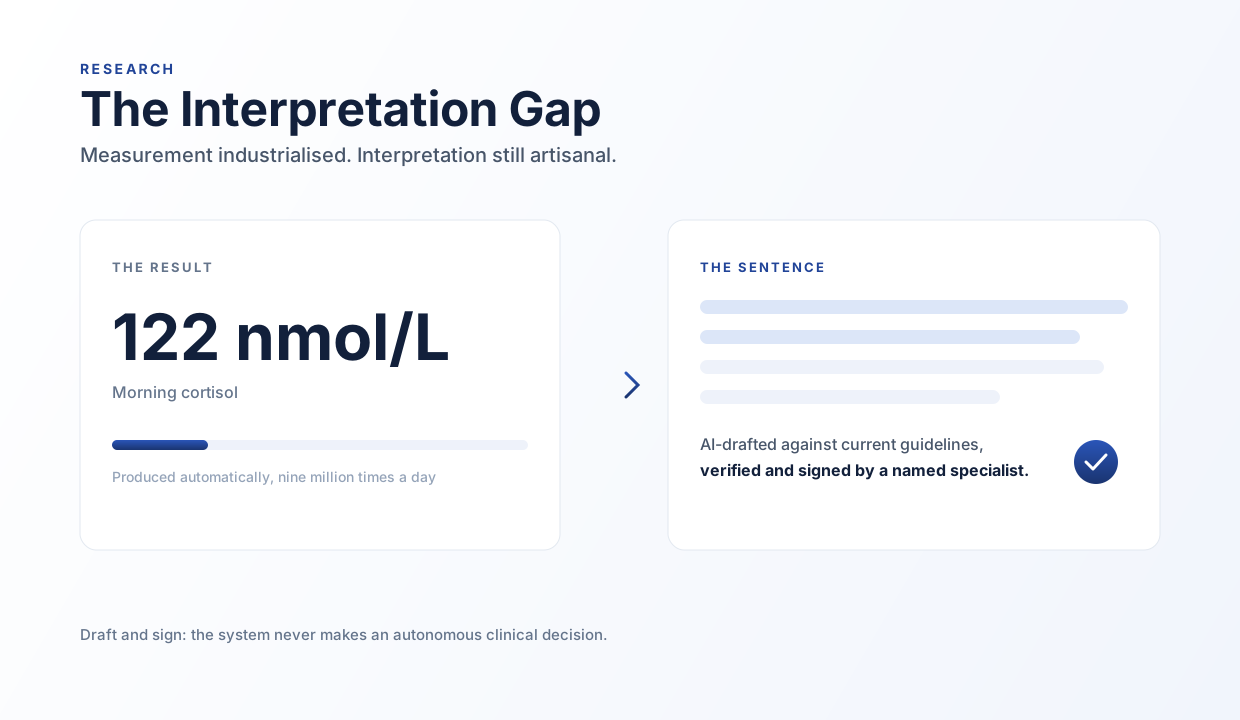
Clinical laboratories in Germany put out around nine million results a day [1]. I keep coming back to that number, because it hides a strange inversion: the part of laboratory medicine we automated is the part that used to be hard work, but the part we left manual is the part that was always the most important.
“The result is a number. What the treating physician needs is a sentence.”
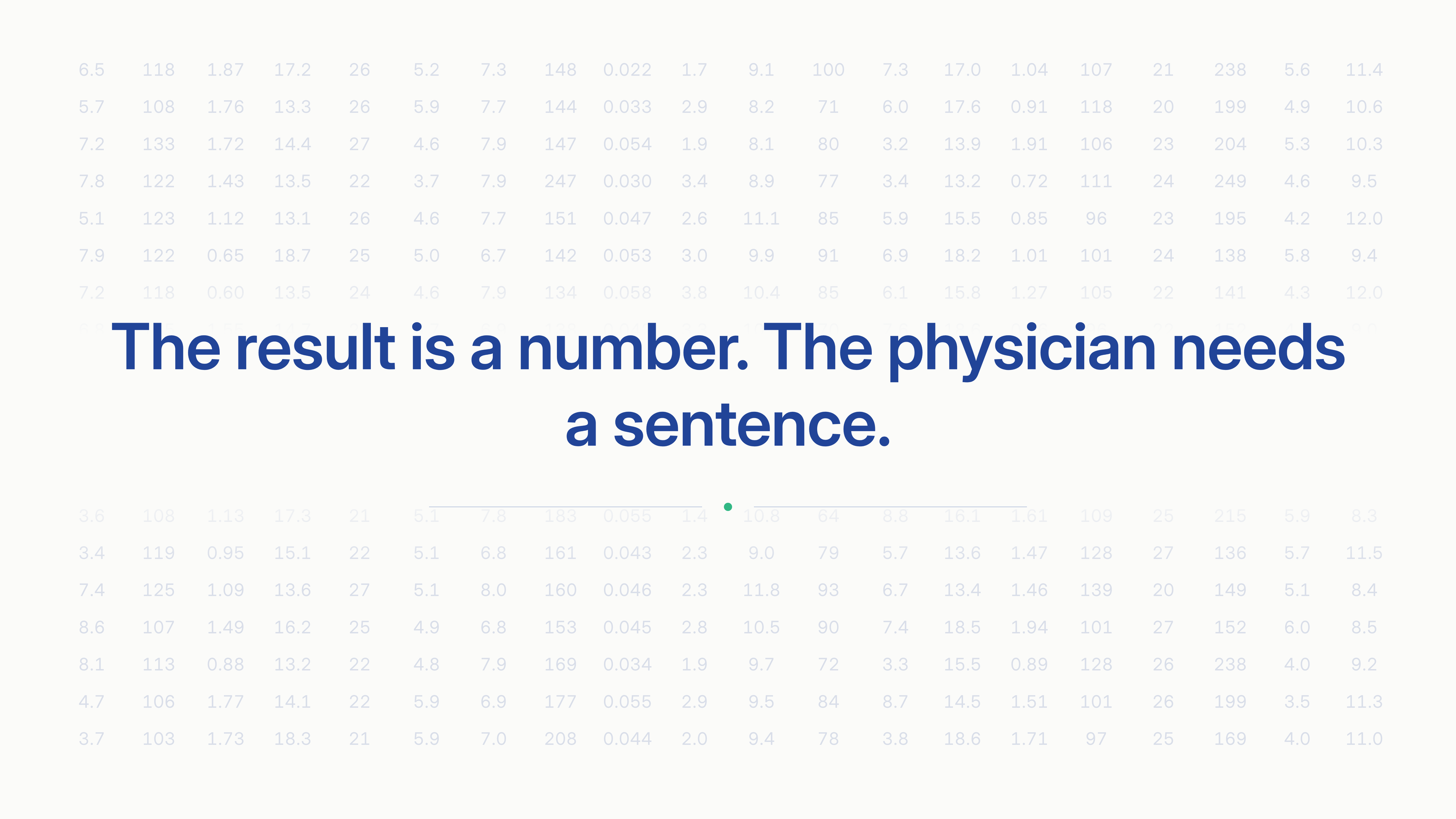
A result is a number. What the treating physician needs is a sentence. “This pattern, in this patient, most likely means X; do Y next.” In practice, the clinical context needed to recommend the next step is not always available to the laboratory; better integration with patient data will be essential. That sentence still gets written the way it was written in 1990: by one of a small number of experienced specialists, one case at a time, usually at the end of the day.
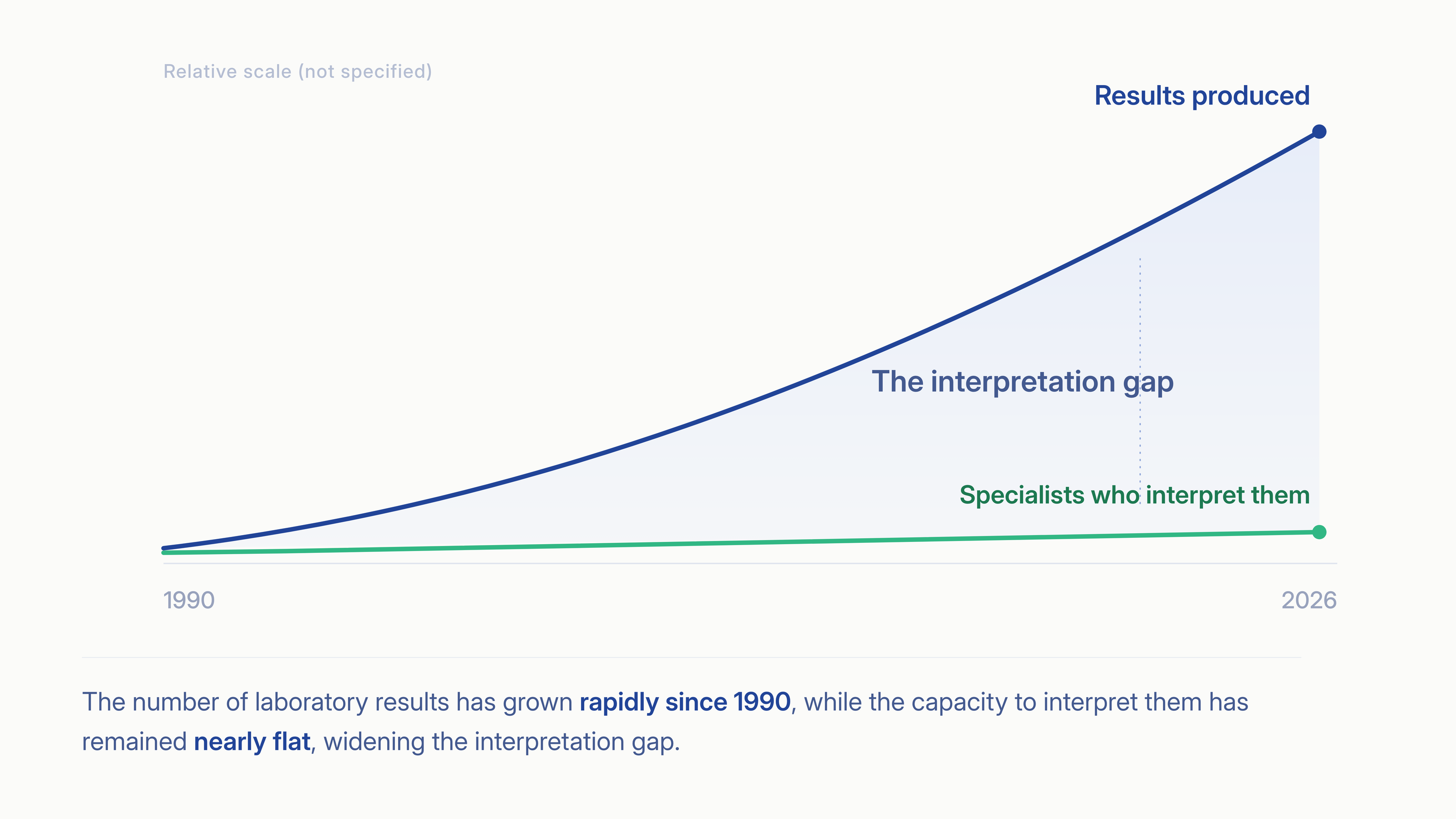
And the queue in front of those specialists is growing. Histopathology requests rise four to five percent a year [2]. Meanwhile the Royal College of Pathologists’ 2025 census found that 78 percent of pathologists consider staffing inadequate, and 47 percent are past fifty [3]. You can do the retirement arithmetic yourself.
The uncomfortable part: automation helped create the conditions for this bottleneck. Once producing another result becomes cheap and routine, testing volumes rise with it. Every extra panel then produces extra demand for judgment, the one thing on the requisition form that no analyser makes. Rising volumes are not the whole causal story; ageing populations and broader test menus play their part. Still: measurement scaled, interpretation did not, and the gap between them has been quietly compounding for decades.
The expert baseline is wider than we admit
Whenever someone proposes AI support for interpretation, the first objection is always the same: can it match the expert?
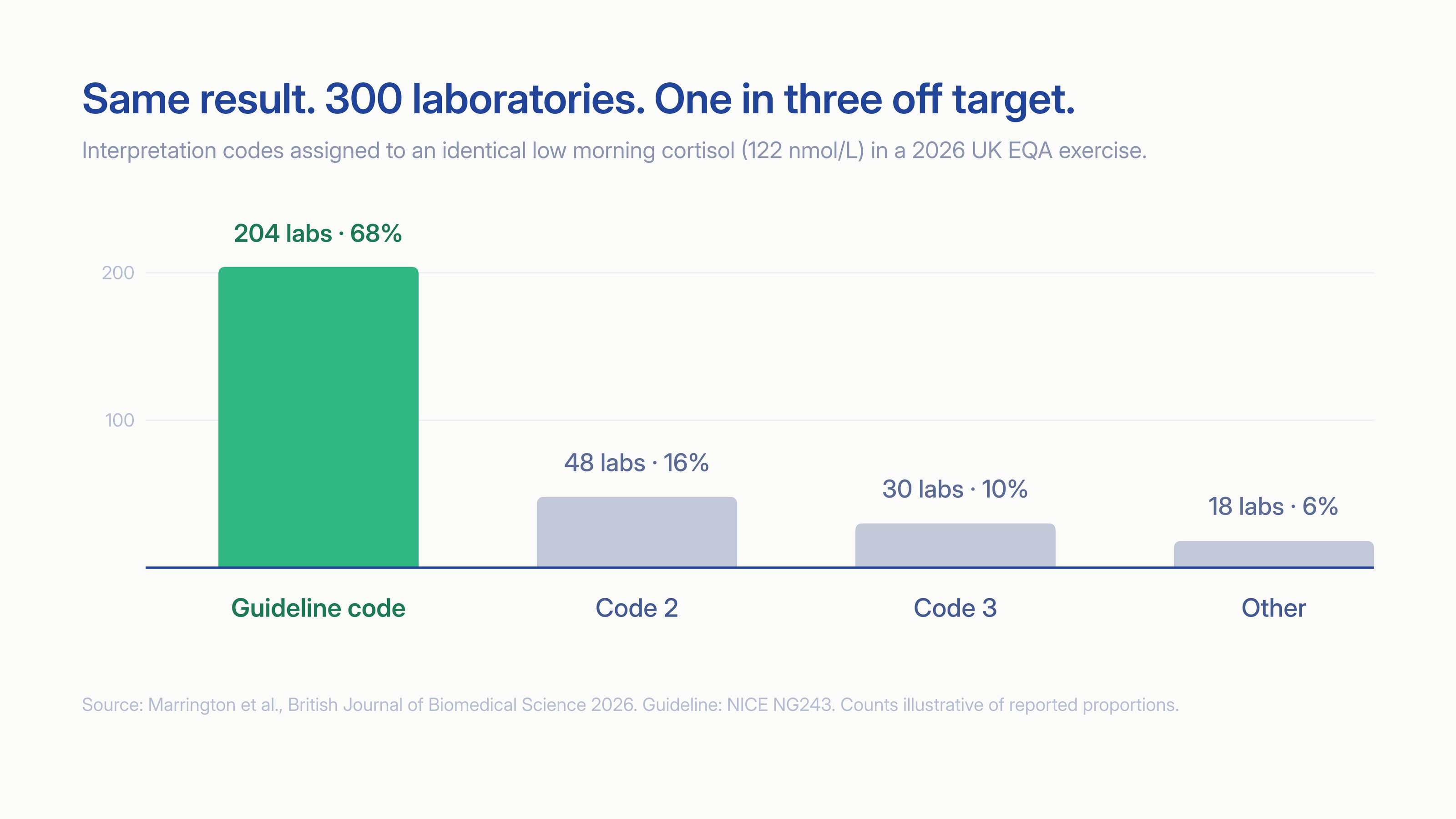
Fair question, wrong baseline. Look at what the field’s own quality-assurance schemes keep finding, and have kept finding for over twenty years. In a 2026 UK EQA exercise, roughly 300 laboratories interpreted the same cortisol results. For a clearly low morning cortisol of 122 nmol/L, 68 percent chose the code the NICE guideline expects. So about a third didn’t. For an intermediate value near 307 nmol/L it got worse: the most popular interpretation wasn’t the guideline’s answer at all [4]. Lim and colleagues documented the same phenomenon back in 2004, with comments on identical cases ranging from excellent to, in their words, dangerous [5]. Two decades apart, same finding. This is a persistent property of the system and not just a bad year.
None of this means laboratories are careless. It means that manual interpretation at scale naturally produces a spread, and the spread is wider than we think. For example, Plebani et al. put the post-analytical phase at roughly a quarter of all laboratory errors [6], and interpretation sits squarely within it.
So the real question is not whether a machine can match some flawless expert. That expert is a fiction. The question is whether machine-drafted, expert-signed interpretation beats the documented spread of current practice.
And a meaningful interpretation is worth fighting for: when laboratory physicians add a written comment, clinicians report it saves them time in about 80 percent of cases and helps avoid a misdiagnosis in about 70 percent [7].
Why static text does not solve the variation
Laboratories are not naive about the workload, and almost nobody writes every comment from scratch. The standard workaround is the text-block library: several hundred pre-written comments, each with its reference values and guideline phrasing baked in, reused thousands of times.
Seen this way, some of the divergence seen in EQA stops being surprising. Three hundred laboratories, three hundred slowly ageing private libraries. That arrangement cannot be the whole explanation for the variation, but it is a structural contributor, and it is the one we can actually fix.
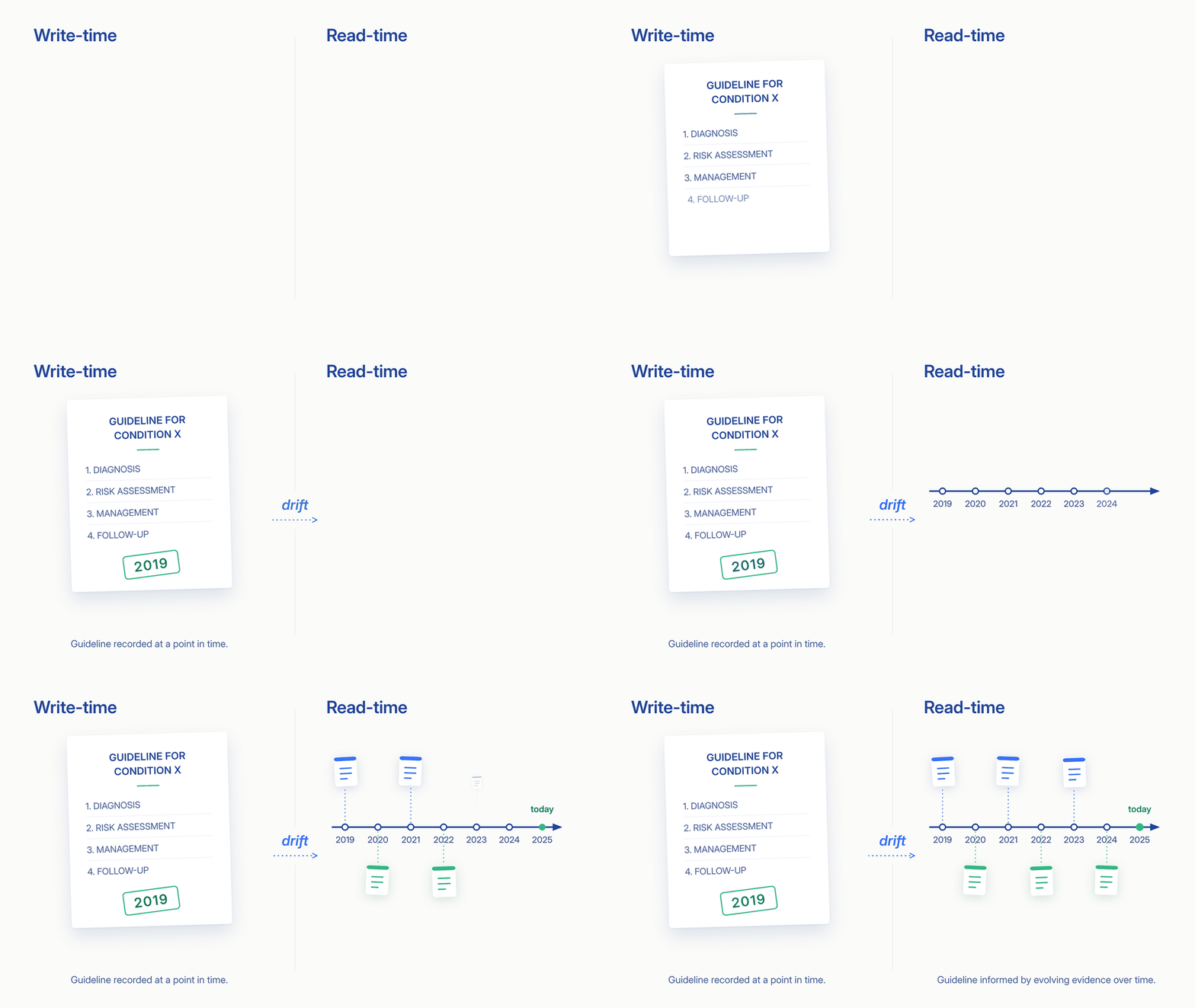
Static libraries freeze thinking: they fix reference values and guideline wording at write-time, and nothing expires them when medicine moves. The fix has to invert the architecture: generate the interpretation when the result is read, against the guideline and reference values as they stand that day, for that patient, and not retrieved from an outdated cache.
Draft and sign
The proposed workflow would look like this: The case goes in with its results and clinical context. The system writes a first interpretation, structured the way a specialist would structure it, grounded in current guidelines, with the evidence behind each statement visible. The specialist reads it, fixes what needs fixing, and signs.
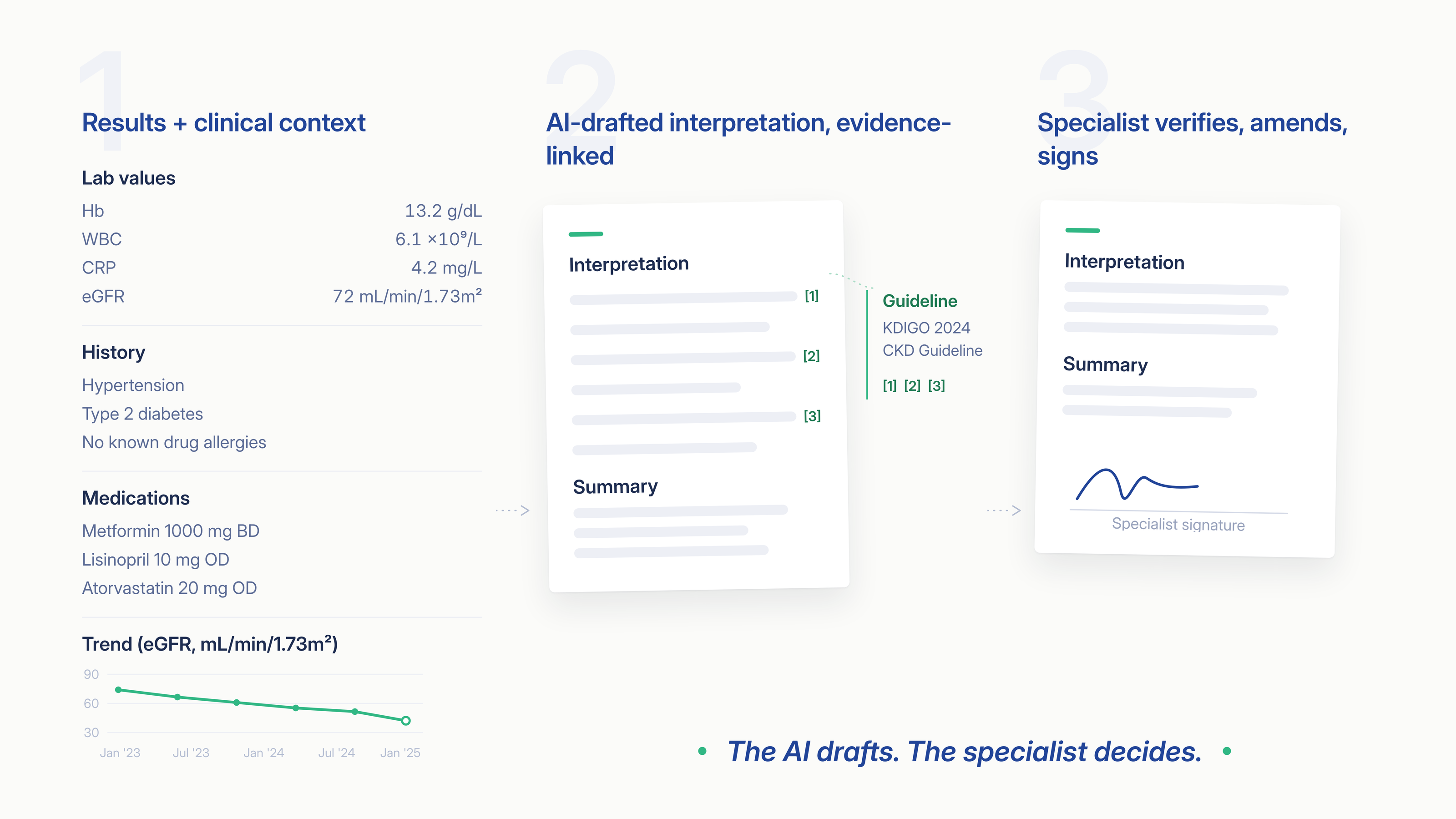
One boundary matters here, clinically and legally: this system does not make an autonomous diagnosis or treatment decision. It produces an evidence-linked draft for a professional to verify, amend and sign. The clinical decision, and the accountability that comes with it, never moves.
A reasonable objection is that this just adds a step. It doesn’t, because writing and checking are different kinds of work. Anyone who has reviewed a colleague’s report knows the feeling: producing the text takes an evening, spotting the flaw in someone else’s takes minutes. Generating an interpretation means juggling the guideline, the ranges, the pattern and the wording all at once. Verifying one means reacting to a concrete proposal. Experts are fast at the second and burn out on the first.
Whether the machine can carry the writing half is a separate question. Recent evidence is encouraging: when you feed a large language model the actual laboratory results, its diagnostic accuracy improves, by up to 30 percent in one evaluation [8]. A pathology-specific copilot scored 90.5 percent on diagnostic questions with clinical context, where a general model managed 63.5 [9]. A study in The Oncologist this year found ChatGPT proposed more therapy options than a human molecular tumour board, median three against one, in under half the time; the authors’ own conclusion was that the future is a hybrid of expert and machine [10]. A growing body of evidence suggests feasibility, but prospective validation will likely be needed for each intended workflow.
Concretely, a fair trial of draft-and-sign would measure the complete workflow, not the model: time per interpretation; concordance with current guidelines against the text-block baseline; clinically significant error rate, which must be equal or lower; the rate of substantive human edits, which should be real and stay real; and reviewer vigilance over time, because the failure mode worth fearing is not week one, it’s month six. If those numbers don’t hold, the idea doesn’t deserve deployment, whatever the benchmark scores say.
That last metric matters most. A study of AI-generated infectious-disease consultations found fewer than two in five responses fully harmless. The detail that should worry us more: the reviewers most likely to wave flawed answers through were the senior specialists [11]. Fluent drafts invite rubber-stamping, and experience apparently makes it easier, not harder, to skim past a confident error.
So “human in the loop” is where safety starts, not where it ends. A successful and compliant system has to make genuine review easy and lazy review awkward. Show which guideline passage supports each claim. Show the reference values it used. Say “uncertain” out loud instead of smoothing it into fluent prose. If the signature ever becomes a formality, the whole arrangement has failed, whatever the accuracy statistics say.
A recent large US study examined emerging safety patterns at the interface of clinicians and AI, highlighting the benefits of specialised models over general-purpose LLMs [12]. If the workflow is engineered well, combined human and machine judgment may lead to more consistent clinical decisions.
Scale the draft, preserve the judgment
If the architecture proves itself here, the interesting question becomes how far the pattern extends: a specialist writing a synthesis others rely on describes more than one job in a hospital. But that is a case for another article, with its own evidence. For how general-purpose chatbots handle clinical questions today, see our comparison of ChatGPT for clinical use.
This one ends where it started. We built machines that answer “what is the number?” nine million times a day, and we observe what happens when “what does it mean?” is left to a shrinking group of people working from ageing libraries of canned text.
We can do better.
FAQ: AI and lab result interpretation
- Can AI interpret lab results?
- Large language models can draft useful lab interpretations, and accuracy improves when the model is given the actual laboratory values, by up to 30 percent in one evaluation [8]. The draft is not a diagnosis: a specialist has to verify, amend and sign it before it reaches the treating physician.
- What is draft-and-sign in laboratory medicine?
- A workflow where an AI system writes the first interpretation of a result, grounded in current guidelines with the supporting evidence visible, and a laboratory specialist checks, corrects and signs it. The clinical decision and the accountability stay with the professional.
- Why are static text-block libraries not enough?
- Static comment libraries freeze reference values and guideline wording at the moment they are written, and every laboratory maintains its own. External quality assessment schemes keep finding wide variation between laboratories interpreting the same case.
- Does a human in the loop make AI interpretation safe?
- Only if the review is genuine. In one study of AI-generated infectious-disease consultations, senior specialists were the reviewers most likely to approve flawed answers [11]. A safe system makes verification easy and rubber-stamping awkward, for example by showing which guideline passage supports each claim.
DR. INFO grounds every AI-drafted answer in current guidelines, with the evidence behind each statement visible for a professional to verify. Try it free.
Get Started with DR. INFO→