Surviving Sepsis Campaign 2026: What Changed Since 2021
Written by Miguel Romano, MD
The Surviving Sepsis Campaign, jointly funded by SCCM and ESICM, published an updated international guideline for adult sepsis and septic shock in March 2026, replacing the 2021 edition. It appeared simultaneously in Critical Care Medicine and Intensive Care Medicine and included 129 statements in total, 46 of them new [1].
Sepsis is still one of the leading causes of death worldwide, which is why a revision like this moves fast into practice, addressing different topics as screening, antibiotic timing, fluid strategy and vasopressor use from the emergency department to the ICU. Some recommendations were strengthened since 2021. Others were softened. Five years of new trial data will do that to a guideline.
How was the Surviving Sepsis Campaign 2026 guideline developed?
A 69-member panel across 23 countries put this update together, 38% of them with current or past practice in low- or middle-income settings. They worked from GRADE methodology, reviewed evidence through June 2025, and took no industry funding. The core of the 2021 guideline stayed intact: early recognition, timely treatment, haemodynamic resuscitation. Antimicrobial stewardship got a much bigger role this time, covering empirical coverage, diagnosis, and when to de-escalate.
What are the key recommendation changes in sepsis 2026?
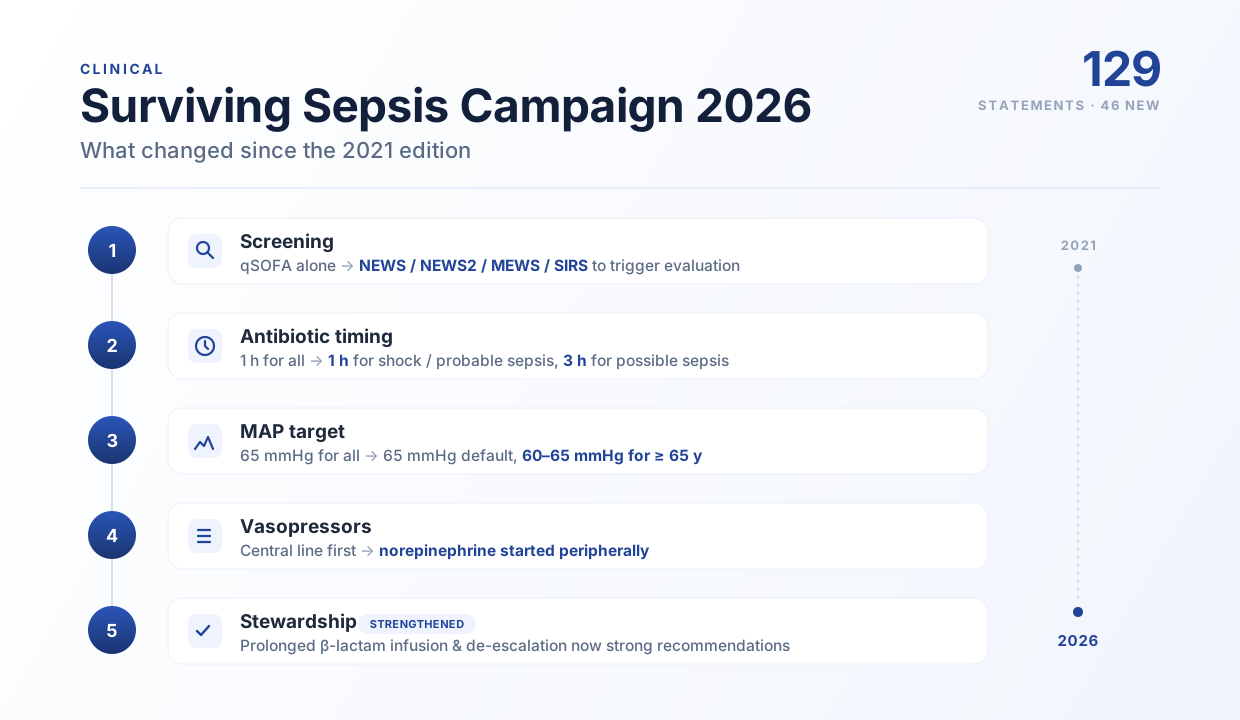
Sepsis is still a clinical judgement, not a number, and the 2026 update leans into that idea. NEWS, NEWS2, MEWS or SIRS are now recommended over qSOFA alone for screening acutely ill patients. A positive score is meant to trigger evaluation rather than confirm a diagnosis on its own.
What screening tools does the 2026 Surviving Sepsis Campaign guideline recommend instead of qSOFA alone?
Open the cited answerOne hour. That is still the target for anyone with septic shock, or with probable or definite sepsis even without shock. What changed is what happens before that clock starts. For possible sepsis without shock, the guideline now asks for a brief, time limited work-up first, and antibiotics only need to be given within three hours if concern for infection persists. Less unnecessary broad-spectrum exposure, without slowing care for patients who are genuinely septic.
A 78-year-old from a nursing home with pneumonia and sepsis, peripheral IV only — within what timeframe should antibiotics start, and what comes first?
Open the worked case65-mmHg has been the default MAP target for years, and it still is for most adults with septic shock. The new wrinkle is for people aged 65 and older: the panel now suggests a lower range, 60 to 65 mmHg, based on conditional evidence that a more permissive target may actually serve older patients better.
30ml/kg of crystalloid, given in the first three hours, remains part of the guideline, but as a conditional recommendation built on low certainty evidence, not a rule to follow blindly. After that first bolus, the panel wants clinicians checking fluid responsiveness with dynamic measures, passive leg raise or pulse-pressure variation, rather than physical exam alone. Balanced crystalloids are still preferred over 0.9% saline.
Central access is no longer a prerequisite. Norepinephrine stays first line, but the guideline now backs starting it through a peripheral line so treatment does not wait on a line that takes time to place.
Two changes here moved from conditional to strong: prolonged infusion of beta-lactams, and de-escalating therapy once susceptibility results come back. On the other side, routine empirical coverage for fungi or anaerobes is now discouraged unless a patient actually has risk factors for either.
What does the 2026 sepsis guideline mean for European practice?
ESICM co-wrote this guideline, so parts of it are already familiar ground here. Early recognition and the 65-mmHg MAP target are nothing new in European ICUs. The newer pieces are landing less evenly: evidence still comes disproportionately from high income settings, and staffing and pharmacy support differ enough across Europe that extended beta-lactam infusion needs real workflow changes, nursing and pharmacy both, before it runs smoothly. In Northern Portugal, at least, that shift already feels more like the norm than the exception.
Vasopressor choice tells a similar story. Vasopressin, sold in Portugal as argipressin, is showing up earlier as a second agent in refractory septic shock, particularly in less differentiated ICUs where options are more limited. It comes with a real cost too: a consistently higher rate of digital ischaemia than norepinephrine, plus mesenteric and myocardial ischaemia, the two complications intensivists worry about most, even though the major trials never showed a significant excess of either [2]. Recent meta-analyses point to a modest mortality reduction with non-adrenergic vasopressors like this one, which probably explains why use is spreading. Just not quickly, and not everywhere [3].
The bottom line for clinicians
None of this means starting over. It means sharper triage on antibiotic timing, a blood pressure target that bends for older patients, and the same clinical judgement it always took before reaching for a second vasopressor. Treat it as the best current synthesis. Not the last word.
See the full Surviving Sepsis Campaign 2026 visual abstract — screening, treatment pillars, and the development panel at a glance.
Open the visual abstractThis is a guideline synthesis for clinical education, not a decision tool. For how general-purpose models compare with retrieval-grounded systems on urgent cases, see our analysis of general-purpose LLMs in emergency triage.
“This article is intended for healthcare professional education and does not replace clinical judgement, local antimicrobial policies or institutional sepsis protocols.”
- What changed in the Surviving Sepsis Campaign 2026 guideline versus 2021?
- The 2026 update has 129 statements, 46 of them new. The main shifts are: NEWS, NEWS2, MEWS or SIRS are recommended over qSOFA alone for screening; a brief work-up is allowed before antibiotics in possible sepsis without shock (within 3 hours if concern persists), while the 1-hour target stays for septic shock and probable or definite sepsis; a lower MAP target of 60 to 65 mmHg is suggested for patients aged 65 and older; norepinephrine can be started through a peripheral line; and prolonged beta-lactam infusion and de-escalation on susceptibility moved from conditional to strong recommendations [1].
- When should antibiotics be given under the 2026 sepsis guideline?
- Within 1 hour for septic shock or probable and definite sepsis. For possible sepsis without shock, the 2026 guideline allows a brief, time-limited work-up first, with antibiotics within 3 hours if concern for infection persists. This reduces unnecessary broad-spectrum exposure without delaying care for genuinely septic patients [1].
- What is the MAP target in septic shock in the 2026 guideline?
- 65 mmHg remains the default for most adults with septic shock. For patients aged 65 and older, the panel now suggests a lower, more permissive range of 60 to 65 mmHg, based on conditional evidence that it may serve older patients better [1].
- Can norepinephrine be started through a peripheral line in sepsis?
- Yes. In the 2026 guideline central venous access is no longer a prerequisite. Norepinephrine remains first line, and it can be started through a peripheral line so that treatment is not delayed while central access is obtained [1].
- Does the 2026 guideline still recommend 30 mL/kg of fluid?
- Yes, 30 mL/kg of crystalloid in the first 3 hours remains, but as a conditional recommendation on low-certainty evidence. After the initial bolus, fluid responsiveness should be assessed with dynamic measures such as passive leg raise or pulse-pressure variation, and balanced crystalloids are preferred over 0.9% saline [1].